

Call Purpose
Define whether the agent handles intake, qualification, scheduling, routine support, reminders, or another narrow call objective.
Atlanta, Georgia, USA
AI Voice Agent Development
GHL Technology develops controlled AI voice agents for suitable inbound and outbound call workflows such as intake, qualification, scheduling, request routing, routine support, and approved follow-up. Each voice system is designed around clear disclosure, approved knowledge, consent requirements, human transfer, system permissions, transcripts, monitoring, and measurable call outcomes.
Call System
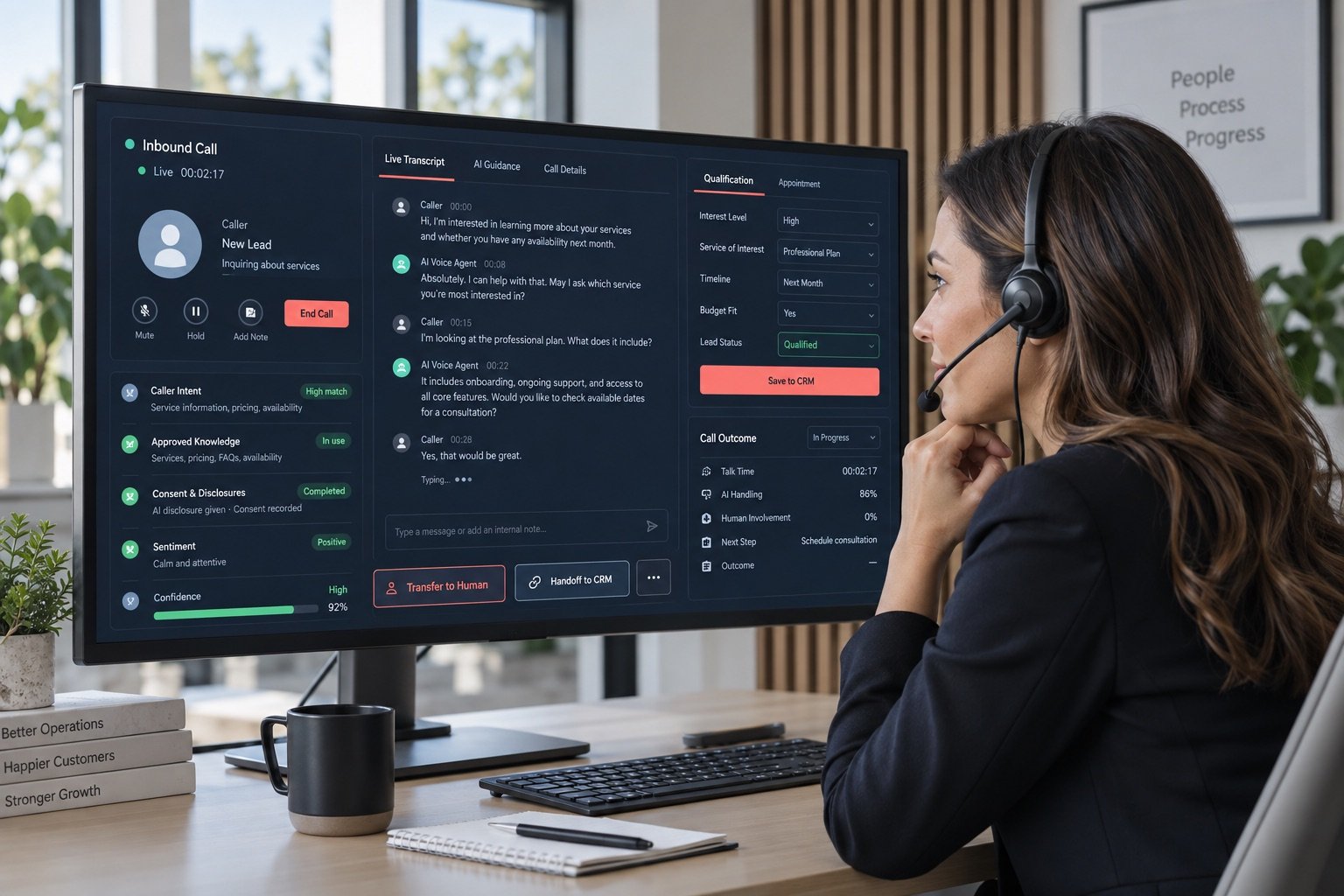
A useful voice agent combines telephony, speech recognition, approved knowledge, conversation logic, system context, transfer rules, transcripts, monitoring, and an accountable business owner.
Define whether the agent handles intake, qualification, scheduling, routine support, reminders, or another narrow call objective.
Identify the automated system appropriately and design recording, consent, and communication practices for the applicable use case.
Ground responses in reviewed service, product, policy, availability, and process information with clear content ownership.
Direct callers by intent, urgency, customer context, service need, or another approved business rule.
Transfer complaints, sensitive issues, uncertainty, complex requests, and consequential decisions with useful conversation context.
Record permitted call context, disposition, follow-up needs, escalation, and operational measurements for review.
Practical Call Workflows
Answer initial service questions, collect relevant business context, identify urgency, and route the opportunity to the right person.
Capture the reason for the call, check approved scheduling context, route departments, and confirm the next step.
Support consented reminders, status updates, or requested follow-up using a defined script, opt-out handling, and human escalation.
Handle suitable common questions, retrieve approved answers, and transfer uncertain or sensitive conversations.
Controlled Call Flow
Identify the automated experience and apply the required consent or recording practice.
Capture intent, clarify context, and avoid assuming facts that the caller did not provide.
Use approved knowledge and permitted tools for the defined purpose.
Hand uncertainty, exceptions, sensitive issues, or requested human help to a person.
Save permitted transcript context, disposition, next step, and outcome for review.
Development Process
Choose the call purpose, audience, channel, owner, boundaries, and measure.
Map scripts, intents, knowledge, systems, disclosure, consent, and transfer rules.
Evaluate accents, interruptions, silence, noise, ambiguity, objections, and failure cases.
Integrate approved telephony, CRM, scheduling, support, and workflow systems.
Review transcripts, transfers, call outcomes, quality, complaints, and business value.
Call Governance
Rules vary by jurisdiction, call type, recording practice, consent, and outreach context. Legal and compliance requirements should be reviewed for the intended implementation before production use.
An AI voice agent is a software system designed to handle a bounded telephone conversation using speech recognition, approved knowledge, conversation rules, and permitted tools. It should disclose its role appropriately and transfer callers to a person when required.
Suitable use cases may include initial call intake, basic qualification, scheduling, request routing, routine questions, reminders, status updates, and approved follow-up. Complex, sensitive, uncertain, or consequential conversations should retain human involvement.
Yes. A planned implementation can transfer based on caller request, low confidence, urgency, complaints, sensitive information, unsupported questions, or another defined escalation rule while passing useful context to the human recipient.
Depending on available APIs and permissions, a voice agent may connect to telephony, CRM, scheduling, support, ecommerce, knowledge, and workflow systems. Access and integration feasibility must be validated before implementation.
Requirements may vary by jurisdiction and use case, including disclosure, recording consent, outreach consent, opt-out handling, privacy, retention, and industry obligations. Appropriate legal and compliance review is required before production use.
Evaluate A Real Call Journey
Share the call type, audience, current routing, common questions, systems, transfer needs, and desired outcome. GHL will assess whether a voice agent, chatbot, workflow, or conventional call process is the right fit.